
What is Quantitative Reasoning?
Quantitative Reasoning is a mathematical subject that focuses on the application of numerical and logical thinking to solve real-world problems. It emphasizes understanding and analyzing quantitative information to make informed decisions in everyday life, work, and academics.
Key Concepts:
Numerical Literacy: Understanding numbers, percentages, ratios, and how they relate to real-life contexts.
Proportional Reasoning: Solving problems involving ratios, rates, scaling, and unit conversions.
Estimation and Approximation: Making reasonable predictions and simplifying complex calculations.
Data Interpretation: Reading and analyzing charts, graphs, and tables to draw conclusions.
Probability and Statistics: Understanding chance, risk, and data trends to make evidence-based judgments.
Mathematical Modeling: Creating simple mathematical representations of real-world scenarios.
Applications:
Personal Finance: Budgeting, calculating interest, and managing expenses.
Health and Medicine: Understanding medical statistics, dosages, and risk analysis.
Public Policy: Interpreting data in news, economics, and social issues.
STEM Fields: Building foundational skills for science, technology, engineering, and math careers.
Everyday Decision-Making: Evaluating options using logic, numbers, and evidence.
Quantitative Reasoning develops critical thinking and analytical skills, empowering learners to confidently engage with the quantitative demands of modern life.
What is Mathematical Thinking and Quantitative Reasoning?
Mathematical Thinking and Quantitative Reasoning is a foundational subject that emphasizes logical reasoning, problem-solving, and the effective use of numerical information to analyze real world situations. Rather than focusing solely on formulas and computation, it develops the ability to think critically, recognize patterns, and make justified conclusions using quantitative evidence.
Key Concepts:
Logical Reasoning: Developing structured, step-by-step thinking to analyze problems and arguments.
Problem Solving: Applying mathematical ideas to unfamiliar and practical situations.
Quantitative Literacy: Understanding, interpreting, and communicating numerical data accurately.
Patterns and Relationships: Identifying trends and connections between quantities.
Estimation and Approximation: Making reasonable judgments when exact answers are unnecessary or unavailable.
Data Interpretation: Analyzing graphs, tables, and statistics to draw meaningful conclusions.
Applications:
Everyday Decision-Making: Evaluating financial choices, risks, and real-life scenarios.
Business and Economics: Interpreting data, forecasting trends, and assessing outcomes.
Social Sciences: Understanding surveys, statistical claims, and research findings.
Technology and Science: Supporting analytical thinking required for technical fields.
Academic Success: Strengthening reasoning skills applicable across disciplines.
Mathematical Thinking and Quantitative Reasoning equips learners with essential skills to approach problems logically, interpret information confidently, and make informed decisions in both professional and everyday contexts.
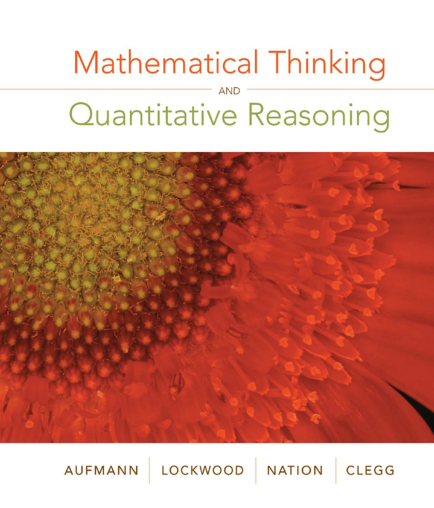
Mathematical Thinking and Quantitative Reasoning
Richard N. Aufmann

PreCalculus
Ron Larson

Basic Mathematics
ALAN S.TUSSY

Vector Analysis
Jeffrey Bennett

Tools for Quantitative Reasoning
Honey Notes